.png)
The Theologian Who Proved Why AI Will Never Surpass Humans (Part 1)

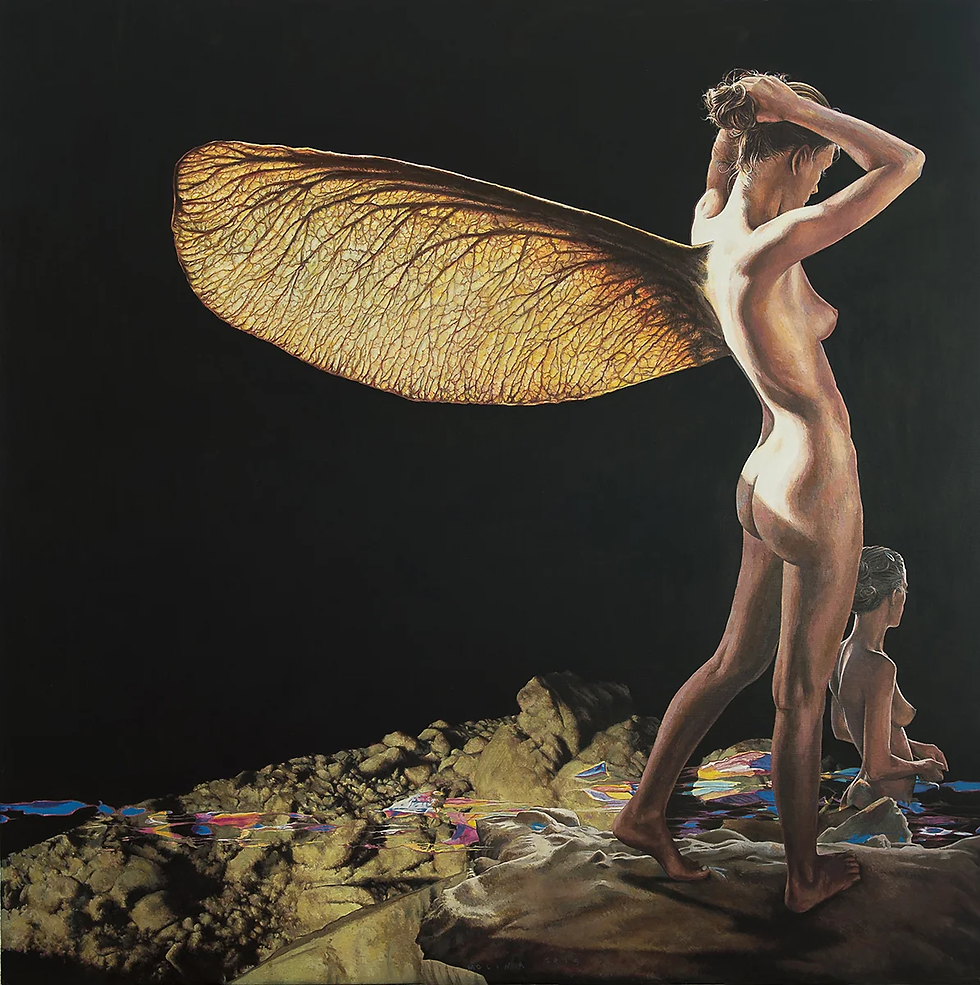
One of the artists whose works I've loved the most is José Molina, particularly his series “Cosas humanas” and “Los olvidados.” I once asked him how he decided, after months of work, when a piece was finished. He replied: “I don't decide when a work is finished; it decides for itself.”

About 10 years have passed since that phrase, and today I find it similar to another statement: man will continue to ask questions until everything that needs to be understood has been understood. This was stated by the theologian Bernard Lonergan in (Insight: A Study of Human Understanding, 1957). With this statement, Lonergan affirms humanity's superiority over machines. It is Robert J. Spitzer, in Why is Human Self-Consciousness Different from Artificial Intelligence and Animal Consciousness, who brings up this reasoning, seeing Lonergan as the culmination of an argument that begins with Plato and continues with Albert Einstein, Michael Polanyi, Alfred North Whitehead, and Sir Arthur Eddington. We touched upon this in a previous article, as highlighted by Shannon's fundamental theorems (How information is measured and why God is the source of all doubt), hypothesizing that doubt originated from God, or let's say from a supernatural force; in this scientific paper, we seemed to receive a formal contribution in that direction.
“To be,” for Lonergan, is equivalent to the awareness that everything there is to know must be known. No algorithm, as Spitzer demonstrates, can ever “be” in this sense. Only a state of pre-established need, we would dare to say inherent in human ontology and correlated with a pre-chemical and pre-biological reality, can create this need, like a light that drives creation. There is never any reference to God or a god in the scientific papers we cite, but, as we have repeatedly pointed out in our reasoning, without a dimension transcendent to matter, it is not possible to demonstrate the superiority of biological humanity over a hypothetical bionic humanity; we take this as given.

The reasoning also touches upon the topic of quantum physics, which many philosophers point to as the true architect of our consciousness, but which they actually use as a synonym for God. Because talking about God is for bigots, while talking about quantum physics makes one sound like a scientist. No, no one has correlated quantum physics to any excess for humans, just smoke and mirrors for now, it seems to us. However, the “hunger for knowledge” is not just an epistemological fact, but is empirically demonstrable and could resist the skepticism of David Hume, as well as the positivism of Auguste Comte, and the neo-positivist view of Karl Popper (in other words: it holds up against any philosophy of knowledge). He who is (always in the theologian's sense) is not guided only by situational curiosity, but by universal curiosity. This universal and total curiosity is contained in every question, even the most trivial, that we ask. What compels man to want to know everything about everything, what drives him to feel incomplete until every question has been answered? This is what we alluded to in the previous article regarding the nature of information. Lonergan provides an answer: the origin of everything is humanity's need to obtain complete intelligibility, others call it illumination (our metaphor). But a brain that can understand everything most likely does not exist in human nature, so how could this desire for totality have been instilled in the brain, when it can never be achieved? It is to this question that Lonergan appeals to transcendence.
If to be is to go deep and seek to know everything, starting from anything, then for every question, man proceeds with a methodology that consists of giving three-dimensionality to the question, thus asking what, where, when, why, how, who, how much, and how frequently (“what?” “where?” “when?” “why?” “how?” “who?” “how much?” and “how frequently?”). These are the eight ways to know everything about something; if even one of these questions remains unanswered, being remains unsatisfied. For Bernard Lonergan, these eight modes of proceeding are hardwired into our human being and thus constitute the basis of our transcendence. Lonergan completes and surpasses Descartes: I am not because I think, but I am by how I proceed in thinking. It is these modes that push man to create levels of abstraction, correlations, predicates, and complex structures like logic, ontology, mathematics, social sciences, arts, and much more.
The Demonstration
But let's proceed in order and follow Spitzer's far from obvious reasoning. Many, from Hubert Dreyfus in 1972 (we cited him here: Artificial Intelligence, philosophically speaking pt. 1) to the present day with Federico Faggin, Luciano Floridi, and Noam Chomsky, great philosophers and scientists have pointed to AI as truly limited by the fact that it does not have consciousness, even with the inability to define what consciousness is. However, the research followed by Spitzer seems to us very intelligible and formal.

First, let's start with Kurt Gödel's theorem, which demonstrated that the way humans develop mathematics is not, and never will be, imitable by any machine.
The theorem formally postulates:
First Incompleteness Theorem: In any consistent formal system powerful enough to include the arithmetic of natural numbers, there are propositions that are true but cannot be proven within the system itself. This means the system is incomplete: it cannot prove all mathematical truths.
Second Incompleteness Theorem: No consistent formal system can prove its own consistency from within the system itself. In other words, for a consistent formal system, it is not possible to prove, using only the rules and axioms of the system, that it does not contain contradictions.

To put it simply, we humans know some truths of arithmetic that no computer could ever know, or rather, even if we taught them, we could always find at least one further truth that is incomprehensible to them (they wouldn't be able to prove its truth or falsity), and so on infinitely. Gödel demonstrated that our understanding of mathematics is broader than the understanding any computational system can have. Kurt Gödel demonstrated and published his incompleteness theorems in 1931. His work, titled Über formal unentscheidbare Sätze der Principia Mathematica und verwandter Systeme (in English: “On Formally Undecidable Propositions of Principia Mathematica and Related Systems”), was published in the journal “Monatshefte für Mathematik und Physik.” This work revolutionized logic and the philosophy of mathematics, highlighting the fundamental limits of formal systems.
In the next part, we will see how Spitzer develops the demonstration, moving his reasoning from Gödel.


Comments